
Pixfra Thermal Buyer's Guide: Which Model for What (2026)
G'day. Pixfra makes a lot of thermal for the money, but the range has grown fast and the model names don't tell you much at a glance. This guide sorts it by what you hunt and how far away it usually is, so you can land on the right Pixfra without wading through spec sheets.
Prices below are Pixfra RRP as at 24 October 2026. These models ship to you from the Australian distributor, so allow a few extra days. If you're stuck between two, ask us and we'll give you a straight answer.

Start with distance, not features
The one rule that saves the most money: match the lens to the distance you actually shoot. If most of your animals are inside about 150 m, a 19 to 35 mm lens gives you a wider view that's easier to work with, especially in scrub and timber. If you regularly need to identify foxes at 250 m or deer across a gully, go 50 mm. A bigger lens on a close-range property just means a narrower view and more weight on the rifle.
Sensor resolution comes second. A 384×288 sensor is plenty for most rabbit and fox work. A 640×512 sensor shows more detail at any distance, which helps when you're sorting a fox from a feral cat or checking the background behind an animal. Laser rangefinders come third, and they're more useful than most people expect once you've hunted with one.
Rabbits and foxes around the house paddocks
This is close, busy work. You want a wide view, a quick start-up and something that doesn't wear you out by midnight.
- Pixfra M2 M419 ($1,390). 384×288 sensor, wide 19 mm lens, Wi-Fi, an electronic compass and IP67. It's the pocket handheld we'd point most first-time thermal buyers at.
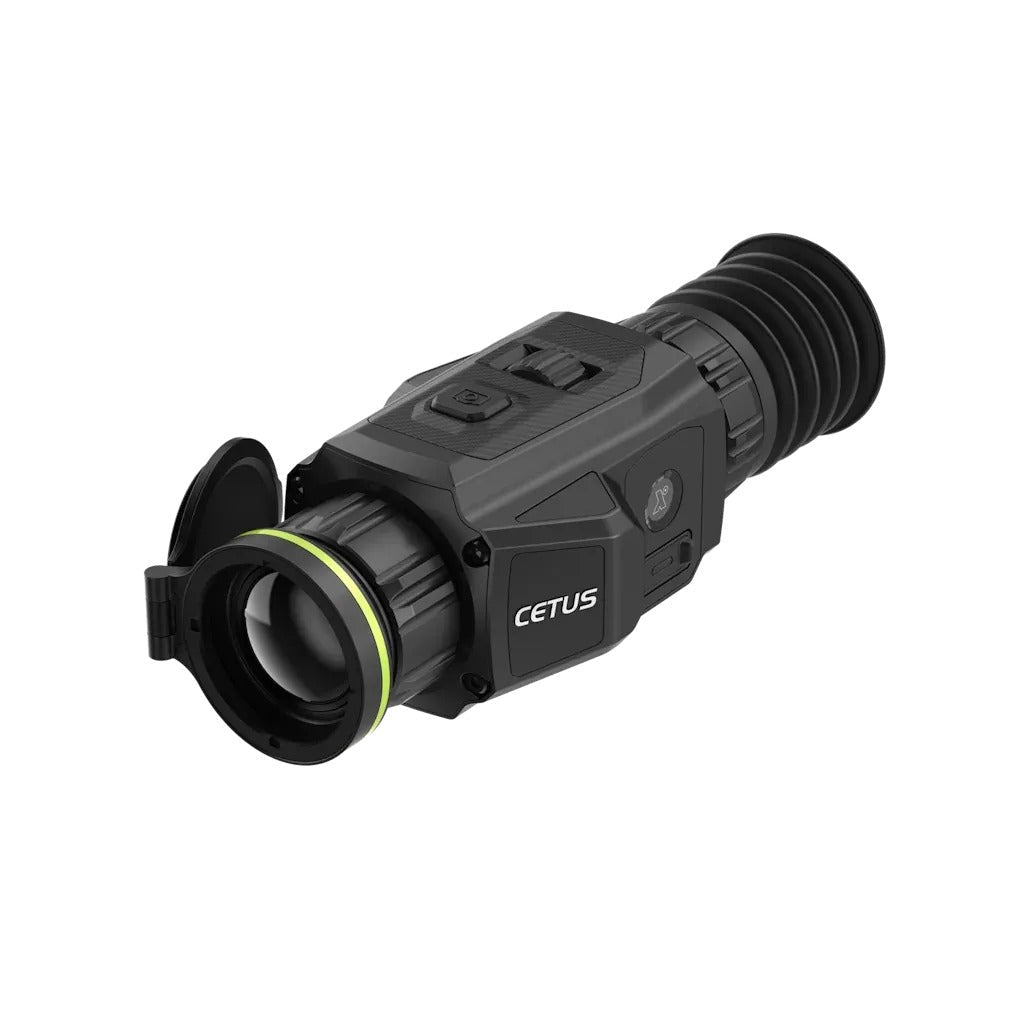
- Pixfra Cetus C225 ($1,190). 256×192 on a 25 mm lens. The simplest way to put thermal on a rimfire or a .223 for close shooting.
- Pixfra Cetus C335 ($1,890). The step up to 384×288 with a 35 mm lens. A good all-round rabbit and fox scope.
Pair a scope with a handheld. Use the handheld to find and check animals, then bring the rifle up once you know what's there and what's behind it.
Foxes on open country
Foxes on open grazing country often hold out at 200 to 300 m. That's where a 50 mm lens and a rangefinder earn their keep.
- Pixfra Arc A650P LRF ($3,490). 640×512 behind a 50 mm F1.0 lens, with a laser rangefinder to 1,000 m. The handheld for open paddocks.
- Pixfra Pegasus 2 P650 LRF ($4,490). 640×512, 50 mm, a 1,000 m rangefinder and a ballistic calculator, in a 30 mm tube that sits in standard rings.
- Pixfra Cetus C650 ($3,890). The same 640×512 and 50 mm idea without the rangefinder, if you already carry one.

Pigs in cane, creeks and crops
Pig work is often closer than people think. You're usually in lignum, along a creek or on the edge of a crop. A 35 mm lens is the sweet spot here: wide enough to follow a mob moving through cover, with enough reach for the far side of a paddock.
- Pixfra Arc A635P LRF ($2,790). 640×512 on a 35 mm lens with a rangefinder. A strong pig-hunting handheld.
- Pixfra Pegasus 2 P635 LRF ($3,890) or Cetus C635 ($2,690). Both are 640×512 on 35 mm. Pegasus 2 adds the rangefinder and ballistics.
- Pixfra Draco D635 ($3,990). If you'd rather glass with both eyes, the Draco gives you thermal, 4K digital night vision and a rangefinder in one binocular.
Deer
Deer means checking the animal properly, both the species and the background, so detail matters more than raw reach. Go 640×512 if the budget allows. In timber, 35 mm is usually right. On open faces and across gullies, go 50 mm. Make sure you know the rules for spotlighting and thermal in your state and on the land you hunt, as they vary.
The Arc A635P LRF and Arc A650P LRF are the handhelds to look at. Draco binoculars are worth a hard look if you spend long nights glassing.
Already own a good day scope?
A Taurus clip-on sits in front of your existing day scope, up to 10× magnification, so you keep your zero and your familiar reticle. The Taurus T435 ($2,450) is 384×288 on a 35 mm lens. The Taurus T635 LRF ($3,490) steps up to 640×512 and adds a rangefinder and ballistics. You'll need the Taurus adaptor that matches your scope's objective bell.

Want day and night in one scope?
The Volans 50 ($1,190) is a 4K digital scope you can use by day and, with infrared, at night. It's a different tool from thermal. It shows you a picture, not heat, so it won't pick an animal out of long grass the way thermal does. It does show detail and texture well, and it costs a lot less to get started. The kit ($1,250) adds a torch and QD rings, and the LRF kit ($1,490) adds a rangefinder and ballistics too.
Quick picks
- Tightest budget, close range: Cetus C225 scope plus the M2 M419 handheld.
- Best all-rounder under 150 m: Arc A635P LRF with a Cetus C635.
- Open country foxes: Arc A650P LRF with a Pegasus 2 P650 LRF.
- Keep your day scope: Taurus T435.
Still weighing it up? Read our Pixfra monocular comparison, the Cetus vs Pegasus 2 vs Volans scope breakdown, and our honest take on Pixfra vs Pulsar vs HIKMICRO. Or browse the full Pixfra range.